First To Summit
by Audrey Salkeld
With their pre-war history of Everest climbing attempts, the British had come
to regard the highest mountain in the world with a certain sense of propriety.
That Swiss mountaineers had so nearly achieved success in scaling it in 1952
had come as a tremendous shock. The Nepalese government had granted permission
for a British assault in 1953, but other nationalities were in line after that
and it was by no means certain when a team from Britain might have another
opportunity to pit itself against the mountain. If they were to retain their
special link with Everest, it was clear in British climbing circles that the
mountain had to be climbed in 1953. Moreover, with a new young Queen about to
be crowned, it was an auspicious year for demonstrations of British
achievement. The pressure to succeed was high, and its first manifestation
came in the replacement of Eric Shipton as expedition leader elect by the
military mountaineer with a flair for organisation, Colonel John Hunt.
 To many, this was a shocking, even treacherous move. Eric Shipton was the
leading British explorer and a popular and romantic public figure; to oust him
now smacked of backdoor diplomacy, and many climbers earmarked for the team
wavered over whether to transfer their alliegances to Hunt. For his part,
Hunt, the fairest of men, was unhappy with the awkward position he found
himself in, and immediately sought to win over the waverers, and indeed
Shipton. But Shipton, bitterly disappointed by the turn of events, withdrew
from the venture altogether. Apart from the way the matter was handled, the
outcome was for the best, for it is doubtful if Shipton could have brought the
same utter dedication to the task as did Hunt. Gaining a summit - even the
loftiest summit in the world - was never as important to him as seeing what lay
around the next corner. He was an explorer, rather than a climber, and wary of
over-organization.
To many, this was a shocking, even treacherous move. Eric Shipton was the
leading British explorer and a popular and romantic public figure; to oust him
now smacked of backdoor diplomacy, and many climbers earmarked for the team
wavered over whether to transfer their alliegances to Hunt. For his part,
Hunt, the fairest of men, was unhappy with the awkward position he found
himself in, and immediately sought to win over the waverers, and indeed
Shipton. But Shipton, bitterly disappointed by the turn of events, withdrew
from the venture altogether. Apart from the way the matter was handled, the
outcome was for the best, for it is doubtful if Shipton could have brought the
same utter dedication to the task as did Hunt. Gaining a summit - even the
loftiest summit in the world - was never as important to him as seeing what lay
around the next corner. He was an explorer, rather than a climber, and wary of
over-organization.
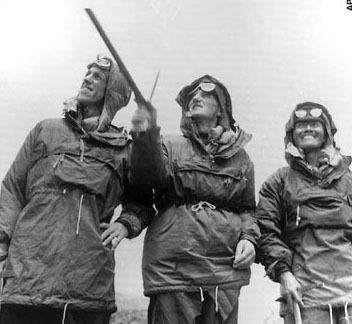
Hunt put together a very strong team of climbers, picking widely on
experience and from keen student mountaineers. No longer was this to be a clique
of Alpine Club friends, but the best the country or rather, the
Commonwealth, could offer. New Zealanders Ed Hillary and George Lowe
were included in the team, as was Sherpa Tenzing Norgay, who was resident in India, as a
full climbing member. Others included: Charles Evans (as Deputy Leader),
George Band (at 22, the youngest in the team), Tom Bourdillon, Alf Gregory,
Wilfrid Noyce, Dr Mike Ward, Michael Westmacott, and Charles Wylie. Dr Griffith
Pugh was the expedition's physiologist, and his preparatory work on Cho Oyu
the year before had been instrumental in the planning of all aspects of
equipment, clothing, and nutrition, as well as recommended rates and usage of
artificial oxygen. His contribution to the team's eventual success should not be
under-estimated. Tom Stobart was the official filmmaker to the enterprise and
James Morris, a correspondent for The Times of London, was instrumental in
sending out the coded message that ensured news of success broke in England on
the Coronation Day of Queen Elizabeth II.
With impeccable planning, a series of camps were set up and the expedition
route pushed forward up the mountain. A new passage was forged through the
awesome and ever-shifting Khumbu Icefall, and the South Face of Lhotse
traversed to reach the South Col. On the 26 of May, Charles Evans and Tom
Bourdillon, using the closed-circuit oxygen apparatus designed by Bourdillon
with his father, launched the first summit attempt. They pushed beyond the
Swiss high point of the previous year to surmount the South Summit, at 28,750
feet, less than 300 ft from the summit proper. Unfortunately, one of their
oxygen sets was not functioning properly and, bitterly disappointed, they were
forced to abort their attempt.
Next, it was the turn of Ed Hillary and Tenzing Norgay, generally regarded as
the strongest and fittest members of the expedition at that time. An
additional high camp was set up above the South Col at 27,900 ft, where the
pair spent a fitful night, waiting for dawn. Before first light on the 28th of
May the long process of getting warmed up and ready began. It was important to
drink what they could to prevent dehydration and their little cooker was
started up to melt ice for water. Hillary's boots were frozen and he sought to
thaw them out over the little flame. Way down in the darkness the lights of
Tengboche Monastery could be seen, where they knew the monks would already be
making offererings for their safety. By 6:30 a.m. they were dressed warmly in
their down suits and crawled out into the new day, hoisted their oxygen sets
onto their shoulders and started kicking steps towards the main ridge and the
wash of sunlight.
Snow conditions were not good and in places the southeast ridge narrowed to a
knife-edge, but they plodded on slowly and gained the South Summit by 9 a.m.
The looping ridge ahead was weighed down with heavy snow cornices overhanging
the frightfully steep East, or Kangshung Face. They took stock of how much
oxygen was remaining, and then Hillary led a tricky and difficult path,
avoiding the cornices on one side and steep slopes on the other. After an
hour's steady going they came to a steep rocky step, some forty feet high.
They had known of this in advance from aerial photographs, but did not know
whether it could be surmounted. Luckily, Hillary found a crack into which he
was able to partly jam his body and wriggle his way upwards. The obstacle is
still called the Hillary Step today.
Tenzing followed up behind, and the pair continued their switchback progress
along the summit ridge until finally they saw they had passed the last corner.
Ahead of them lay only a snowy dome and the vast plateau of Tibet. 'A few more
whacks of the ice axe in the firm snow, and we stood on top,' Hillary described
later. Hillary sought to shake hands with his partner, but a delighted Tenzing
would have nothing but to fling his arms around his friend's shoulders,
thumping him on the back. It was 11.30 a.m. and the highest point on earth had
at last been trodden by man.
As mentioned, news of the triumph broke around the world on Coronation Day.
The achievement was seen as a propitious omen for the forthcoming era of New
Elizabethans. Hillary, Tenzing, and Hunt became popular international figures,
and throughout the British Commonwealth housing estates and municipal buildings
were named after them. Hunt and Hillary received knighthoods from the young
queen. Tenzing, regrettably, was awarded the inferior British Empire Medal.
All those on the expedition found their lives and careers changed by Everest
success. We can be grateful that Hunt's carefully chosen team was universally
aware of its privilege and that all the members, in their own way, have sought
to use their prestige in public service. Hunt went on to become The Lord Hunt
of Llanvair Warterdine, known for conspicuous work with young people, for the
Pres and the Parole Board and as an international ambassador. Hillary, too,
has held ambassadorial positions but is best known for his work with the
Himalayan Trust, dedicated to improving the lot of the Sherpa community in
Nepal. Most notable is his help in establishing the Khumjung School that has
served for years in educating Sherpa children throughout the Khumbu. Tenzing
founded the Indian Mountaineering Federation with an injunction from President
Nehru to 'train a thousand Tenzings'; throughout his life he remained a smiling
and approachable unofficial ambassador for the Sherpa people. Money earned by
the Everest film and the best-selling book of the expedition was put into the
Mount Everest Foundation to assist future mountaineering projects and has since
dispensed almost $750,000 in grants to over 900 expeditions.
As Lord Hunt has said, the success of his team on Everest was merely the
continuation of the effort of all those who had gone before. Yet we can feel
ourselves fortunate that in him and his team, the world was blessed with men to
match the mountains they climbed.
Audrey Salkeld of Clevedon, England is one of the world's premier
Everest historians and photo researchers. Her photo editing credits include
Everest: The Ultimate Book of the Ultimate Mountain and Everest: The
Best Writing and Pictures from Seventy Years of Human Endeavour.