Early Everest Attempts: 1921-1938
by Audrey Salkeld
In the early years, little was known about the physiological effects of extreme
altitude, and mountaineers the world over wondered if they could possibly
climb Mount Everest, the world's highest mountain. It was a leap into the
world of the unknown, travelling to far off lands and launching huge
expeditions up the slopes of the Himalaya to altitudes no human had ever
experienced. Eric Shipton, considered the best mountaineer of his day and a
veteran of the expeditions to Everest in the 1930s, predicted that Everest
would eventually be climbed, although he was quick to qualify his prediction
with commentary on the physiological limitations of high altitude
mountaineering: "It would seem almost as though there were a cordon drawn
round the upper part of these great peaks beyond which no man may go. The
truth, of course, lies in the fact that, at altitudes of 25,000 feet and
beyond, the effects of low atmospheric pressure upon the human body are so
severe that really difficult mountaineering is impossible and the consequences
even of a mild storm may be deadly, that nothing but the most perfect
conditions of weather and snow offer the slightest chance of success, and that
on the last lap of the climb no party is in a position to choose its day."
The
truth, of course, lies in the fact that, at altitudes of 25,000 feet and
beyond, the effects of low atmospheric pressure upon the human body are so
severe that really difficult mountaineering is impossible and the consequences
even of a mild storm may be deadly, that nothing but the most perfect
conditions of weather and snow offer the slightest chance of success, and that
on the last lap of the climb no party is in a position to choose its day."
Around the turn of the twentieth century, the initial problem of climbing
Everest was not one of height or difficulty, but of merely gaining access to
the mountain. Neither Tibet, nor Nepal, across whose borders Everest
straddles, welcomed outsiders. Only through top level diplomacy and a personal
appeal to the Dalai Lama was permission finally secured for a British
reconnaissance party to visit Tibet in 1921. Their goal was to ascertain if a
route to the summit of Mount Everest could be found. Unlike our Everest Quest
expedition, which is approaching the summit from the south side, these first
explorers approached from the north.
A small group of seasoned travellers - one or two mountaineers as well as a few
naturalists and surveyors - set off from Darjeeling on May 13th of that year
under the leadership of Colonel C.K. Howard-Bury, an Irish aristocrat. The
expedition's oxygen expert, Dr. A.M. Kellas, who joined the party in India
straight from another strenuous excursion, died of altitude-aggravated
dysentery during the six-week march towards Everest, and the health of the
mountaineering leader, Harold Raeburn, also broke down. George Leigh Mallory
assumed responsibility for most of the exploration to the north and east of the
mountain.
After four months of circling and studying Everest, they were within striking
distance of setting foot on the mountain itself. After a cold night's camp
near the top of Windy Gap, they set off across the East Rongbuk basin with
surveyor Wheeler and some porters towards the slopes of the North Col, and
began to climb its icy slopes. A gale was raging on top, whipping snow into
whirlwinds of deep snow. They took a few
steps into it before being forced back. Still to Mallory's experienced eye, the
route ahead from there to the summit looked long, but feasible for a fresher
party.
British expeditions, including George Mallory, returned in 1922 and 1924. In
'22, George Ingle Finch and Geoffrey Bruce reached the historic height of over
27,000 feet, using flimsy and cumbersome oxygen apparatus. But that still
left 2,000 feet of altitude and a full mile of climbing to reach the summit.
When a further attempt was launched by Mallory and others after heavy
snowfall, the team triggered an avalanche from the laden slopes of the North
Col. Seven Sherpa porters were killed and Mallory was devastated with guilt.
In 1924, British mountaineers Norton and Somervell were able to reach a
point at 28,128 ft on the North Face without using artificial oxygen. Their
effort was quickly followed by another, when Mallory attempted the final ascent
with the youngest member of the team, Oxford University student Andrew
('Sandy') Irvine, following the Northeast Ridge line. 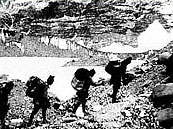 They were climbing with
oxygen and were spotted by Noel Odell towards 1 p.m. on their summit day,
surmounting a rocky step on the ridge and, as Odell recalled, 'going strong for
the top.'
They were climbing with
oxygen and were spotted by Noel Odell towards 1 p.m. on their summit day,
surmounting a rocky step on the ridge and, as Odell recalled, 'going strong for
the top.'
They were never seen again, and ever since mountaineers have argued where
exactly the pair were when Odell saw them, and whether they might actually have
reached the summit ahead of Edmund Hillary and Sherpa Tenzing Norgay, the
acknowledged first men to reach the top of this formidable mountain. It
remains one of climbing's greatest mysteries.
After World War II, Tibet was closed to foreigners by the Dalai Lama, and in
1950 Chinese troops marched in. It would be another thirty years before
foreign mountaineers would again be allowed to approach Everest through Tibet,
and it was at that time that Chinese parties were successful on the route that
George Mallory had been unable to complete.
Audrey Salkeld of Clevedon, England is one of the world's premier
Everest historians and photo researchers. Her photo editing credits include
Everest: The Ultimate Book of the Ultimate Mountain and Everest: The
Best Writing and Pictures from Seventy Years of Human Endeavour.